
In recent years, lightweight, low-carbon, and high-performance have become the three main themes of the manufacturing industry. Although traditional metal materials have high strength, they have high density, high processing energy consumption, and are prone to corrosion; Although ordinary short glass fiber reinforced plastic reduces weight significantly, it often performs poorly under long-term loading, alternating high and low temperatures, and thin-walled high-strength requirements. It is in this context that long glass fiber reinforced polypropylene (LGF-PP) and long glass fiber reinforced polyamide (LGF-PA66) stand out as one of the fastest-growing categories in the global modified plastics field.
一、 Core technological advantages of long glass fiber reinforced materials
Unlike short glass fiber reinforced plastics (with fiber lengths typically ranging from 0.2 to 0.6mm), long glass fiber reinforced materials maintain a length of 10-25mm in the resin matrix through special impregnation and extrusion processes, and form a three-dimensional network structure after injection molding.
This structure brings three key performance improvements:
1. Ultra high impact resistance
Long glass fiber network can effectively prevent crack propagation, and the notch impact strength is 40-80% higher than that of short fiber PP/PA. At a low temperature of -40 ℃, ordinary materials are prone to brittle fracture, while long glass fiber materials can still maintain over 80% of their room temperature impact performance.
2. Excellent creep resistance and dimensional stability
Under long-term static loads (such as car interior frames and home appliance support feet), short fiber materials will undergo significant creep deformation, while long fiberglass materials will have a creep rate reduced by more than 50% due to the support effect of the fiber frame. Meanwhile, in the high and low temperature cycling tests between -40 ℃ and 120 ℃, the warpage deformation of long glass fiber products is only about one-third of that of short fibers.
3. High strength and lightweight
The density is only 1/2~1/3 of aluminum alloys (LGF-PP is about 1.0~1.2 g/cm ³, LGF-PA66 is about 1.3~1.5 g/cm ³), but the specific strength (strength/density) is close to or even exceeds some aluminum alloys, making it an ideal choice for “replacing steel with plastic”.
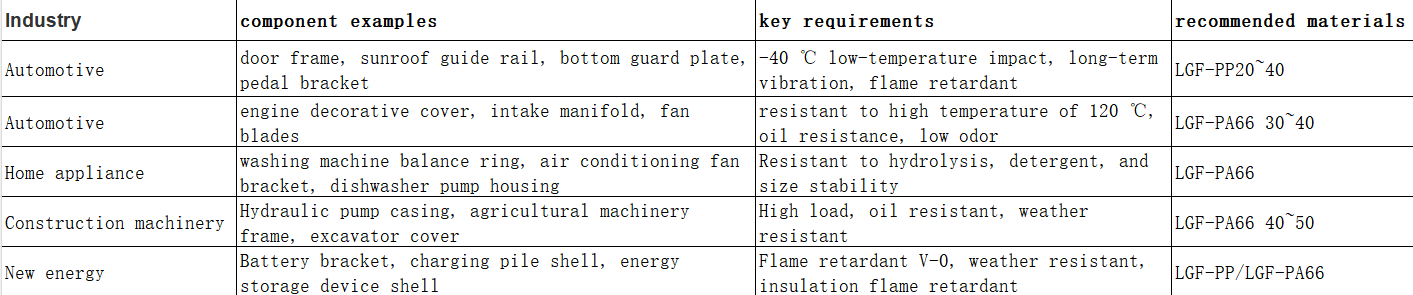
二、 Typical application areas and their specific requirements for materials
三、 Market Trend Data
According to third-party statistics, the global market size of long glass fiber reinforced thermoplastic composites is expected to reach approximately 2.8 billion US dollars in 2023 and is projected to reach 4.5 billion US dollars by 2030, with an annual compound growth rate of 7.2%. Among them, the Asia Pacific region has the fastest growth rate, and China, as a major producer and exporter of modified plastics, is gradually replacing high priced raw materials from Europe and America.
四、 Our positioning
Our company has been focusing on the research and production of LGF-PP and LGF-PA66 for over 20 years, with independent intellectual property rights for continuous long fiber infiltration technology. Our products have been exported in bulk to Europe, Russia, Southeast Asia, the Middle East, South America and other regions. We not only provide standard grades, but also customize formulas according to customers’ usage environments (high and low temperatures, humidity, oil stains, outdoor exposure), helping customers significantly reduce material costs while ensuring performance.
Post time: Jun-08-2026


