
In recent years, lightweight, low-carbon, and high-performance have become the three main themes of the manufacturing industry. Although traditional metal materials have high strength, they have high density, high processing energy consumption, and are prone to corrosion; Although ordinary short glass fiber reinforced plastics have significant weight reduction effects, they perform poorly under requirements such as long-term load-bearing capacity, alternating high and low temperatures, and thin-walled high rigidity.
It is in this context that long glass fiber reinforced polypropylene (LGF-PP) and long glass fiber reinforced polyamide (LGF-PA66) stand out as one of the fastest-growing categories in the global modified plastics field. According to industry statistics, the global market size of long glass fiber reinforced thermoplastic composites is expected to grow from approximately 2.8 billion US dollars in 2023 to 4.5 billion US dollars in 2030, with an annual compound annual growth rate of approximately 7.2%, mainly driven by lightweight regulations and cost pressures.
一、Core technological advantages of long glass fiber reinforced materials
Unlike short glass fiber reinforced plastics (typically 0.2-0.6mm in length), long glass fiber reinforced materials maintain a glass fiber length of 10-25mm in the resin matrix through special impregnation and extrusion processes, and form a three-dimensional network structure after injection molding. It should be noted that the degree of retention of this network structure depends on the screw design and gate form during injection molding; If the process is improper, the length of fiberglass may still decrease significantly.
This structure brings three key performance improvements:
1. Ultra high impact resistance
Long glass fiber network can effectively prevent crack propagation, and its notch impact strength is 40% -80% higher than that of short fiber PP/PA. At a low temperature of -40 ℃, ordinary materials are prone to brittle fracture, while long glass fiber materials can still maintain over 80% of their impact performance at room temperature. The above data is based on ISO 179 or ASTM D256 testing standards.
2. Excellent creep resistance and dimensional stability
Under long-term static loads (such as car frames and home appliance support legs), short fiber materials will undergo significant creep deformation, while long glass fiber materials will have a creep rate reduced by more than 50% due to the support of the glass fiber skeleton. Meanwhile, in the high and low temperature cycling tests from -40 ℃ to 120 ℃, the warpage deformation of long glass fiber products is only about one-third of that of short fibers. This makes LGF material particularly suitable for components with large outdoor temperature fluctuations.
3. Unity of high strength and lightweight
The density is only 1/2-1/3 of aluminum alloy (LGF-PP is about 1.0-1.2 g/cm ³, LGF-PA66 is about 1.3-1.5 g/cm ³), but the specific strength (strength/density) is close to or even exceeds that of some aluminum alloys, making it an ideal choice for achieving “replacing steel with plastic”. For example, the tensile strength of LGF-PP40 can reach 120-150 MPa, and the bending modulus can reach 10-12 GPa, which is sufficient to replace metals for most semi-structured components.
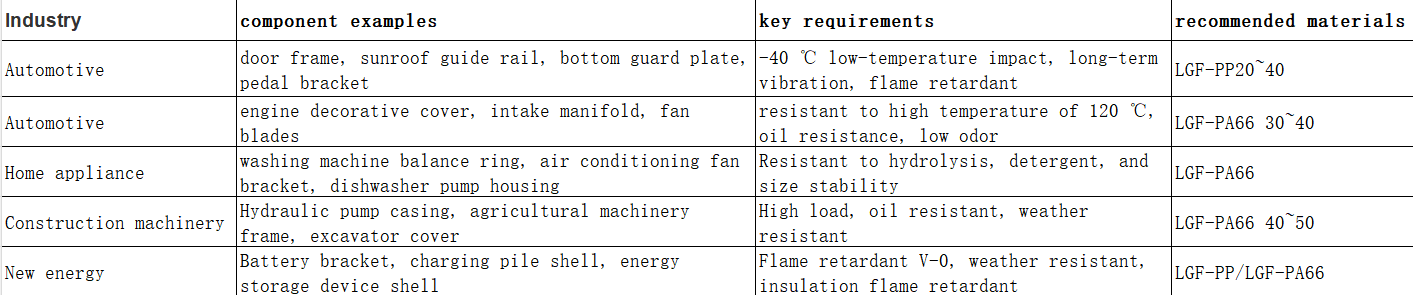
二、 Typical application areas and specific requirements for materials in each field
Industry component examples, key requirements, recommended materials
三、 Market Trend Data
According to third-party statistics, the global market size of long glass fiber reinforced thermoplastic composites is expected to reach approximately 2.8 billion US dollars in 2023, and is projected to reach 4.5 billion US dollars by 2030, with an annual compound growth rate of 7.2%. Data source: Industry reports such as MarketsandMarkets. Among them, the Asia Pacific region has the fastest growth rate, and China, as a major producer and exporter of modified plastics, is gradually replacing expensive European and American raw materials. The core driving force is cost advantage (20% -30% lower than European and American brands) and shorter delivery cycles.
四、 Our positioning
Our company has been focusing on the research and production of LGF-PP and LGF-PA66 for over 20 years, and has an independent process system for continuous long glass fiber impregnation technology. The product has been exported in bulk to Europe, Russia, Southeast Asia, the Middle East, South America and other regions.
We do not claim to be the only or best, but rather provide validated alternatives. Compared to mainstream European and American brands such as SABIC, Celanese, and DSM, our typical cost advantage is 20% -25%, while maintaining 85% -95% of its mechanical performance, which has been validated through batch testing by multiple customers.
We not only provide standard grades, but also customize formulas according to customers’ usage environments (high and low temperatures, humidity, oil stains, outdoor exposure), helping customers significantly reduce material costs while ensuring performance. A practical experience: Customized formulas usually require 4-6 weeks of formula adjustment and sample validation before entering mass production.
Post time: Jun-06-2026


